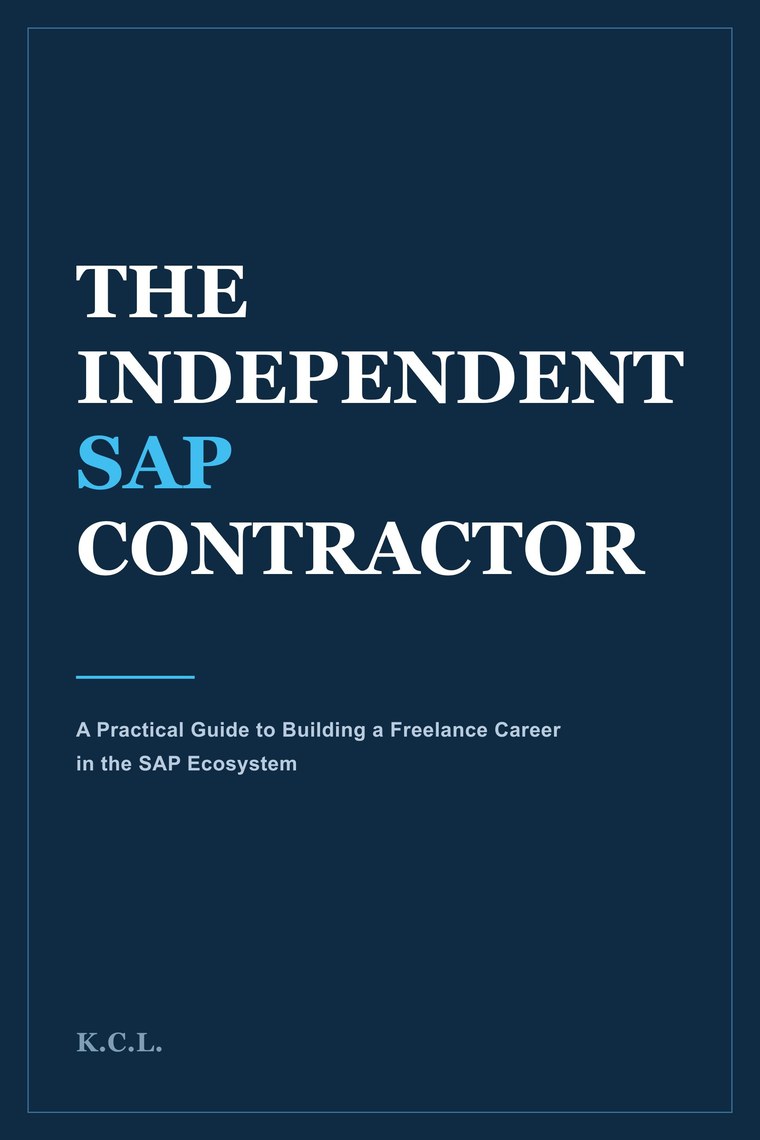
About the book
The honest field guide to going independent in the SAP ecosystem.
There is no shortage of material on how to do SAP — configuring finance, writing ABAP, running a migration, passing a certification. There is remarkably little, in one place, on the business of doing SAP independently: how the contracting market actually works, who thrives in it and who shouldn't try, how to price yourself, structure your business, find work, read a contract, manage lumpy income, and build something that lasts.
The Independent SAP Contractor gathers that knowledge into one honest, structured guide, so you can start from understanding rather than from scratch.
Available now on Amazon in Kindle and paperback editions, or direct as DRM-free EPUB + PDF.
Who this book is for
The consulting-firm consultant
Delivers SAP projects for an employer and wonders what it would mean to do the same work for themselves.
The in-house SAP professional
The analyst or support specialist who has run and enhanced a company's SAP systems for years and suspects their knowledge is worth more on the open market.
The experienced end user
Knows a business process from the inside and is considering the longer road into SAP consulting and contracting.

The paperback
A quiet reference for every independent SAP contractor.
The paperback is built to be an easy reference — you flip to a chapter when you're pricing a contract, reviewing an MSA, or trying to decide whether the market you're looking at is the one you should actually be in.
Kindle and paperback editions are both available now on Amazon.
Paperback edition — available now
What this book is not
- × It is not a get-rich-quick pitch. Chapters 5 and 6 take real trouble to help you decide whether independent contracting fits you at all — including talking some readers out of it.
- × It is not a technical SAP manual. It assumes you already have, or are building, that expertise, and concerns itself with the business of selling it independently.
- × It steers clear of tax, legal, or immigration advice. It gives you the framework and the questions to take to a qualified professional in your jurisdiction, not the answers for your specific situation.
Table of contents
Fifteen chapters in six parts, plus front matter and three appendices.
The SAP Contracting Landscape
Ch 1–4- 1
The SAP market in 2026
The ECC-to-S/4HANA runway and its deadlines. RISE and GROW, Clean Core and BTP, Business AI. Counter-currents, the post-2027 outlook, and what all of it means for someone deciding whether to step into it.
- 2
Types of SAP roles
The types of roles you can play (functional, technical, data, delivery and change, architecture), T-shape thinking, and why scarcity beats seniority. Locating yourself by background.
- 3
Engagement models
The SAP Activate lifecycle and its ramp-down risk. Greenfield, brownfield, bluefield, rollouts, upgrades, AMS, standalone. T&M vs fixed-price vs managed service. Single vs multiple concurrent engagements.
- 4
The contract chain
Client rate vs contractor rate. The four players. Five chain routes from direct to multi-tier VMS. Why the SI rate-card spread often dwarfs the agency margin. Growing toward direct.
Should You Go Independent?
Ch 5–6- 5
Who should consider freelancing
A mirror, not a brochure. The non-negotiable gate: a scarce, delivery-proven skill. Four fit dimensions. Three starting points ranked. When not to go independent, and how to know.
- 6
The honest pros and cons
The day rate lies twice. Gross-up illusion and worked billable-days math. Three fully costed scenarios (UK, Canada, US) that show how a headline rate collapses to a real take-home. The honest ledger.
Making the Leap
Ch 7–8- 7
Preparing to leap
Failures are prep failures. Build pipeline before you quit. Runway, the double gap, and 6-12 months of liquid buffer as negotiating security. Leaving well: notice, covenants, the non-solicit trap.
- 8
Setting up your business
A decision framework, not tax or legal advice. Sole trader through Ltd/corp through umbrella through C2C. The regional-fork table. The recurring am-I-really-independent trap: IR35, PSB, PSI, Scheinselbstständigkeit — and defences.
Finding and Winning Work
Ch 9–11- 9
Finding contracts
The visible-vs-hidden market. Channels ranked: referrals first, specialist recruiters as the volume workhorse, SI roster plays, LinkedIn, SAP ecosystem groups (ASUG, DSAG, UKISUG, SAUG). Reputation is the meta-channel.
- 10
Positioning, brand, and the contractor CV
Positioning as a single sharp sentence. The contractor CV vs the employee CV. LinkedIn as an always-on shopfront. The honest verdict on certifications.
- 11
Rate negotiation
Floor vs target vs ambitious. Market sets the ceiling. Don't undervalue — the number-one error. Anchor high, justify value not need, negotiate the whole package, use silence.
Running the Practice
Ch 12–13- 12
Contract structures and clauses
Education, not legal advice. The MSA + SOW stack. Getting paid, protecting yourself, obligations, framing. Red flags. How status wording affects IR35 / PSB / PSI, and why it must match reality.
- 13
Cash flow, multi-contract operations, and currencies
Profit is not cash. Invoice promptly and chase systematically. Pay yourself a steady salary from a buffered business. Tax money is never yours. Running multiple currencies without over-engineering.
Regional and Long-Term
Ch 14–15- 14
Regional playbooks
A reference chapter, not a read-through. North America (US W-2 / 1099 / C2C / S-corp; Canada incorporation and PSB). Europe (UK IR35, DACH heartland, Nordics). APAC (Australia PSI, Singapore & GCC work authorization, India as delivery engine). LATAM.
- 15
Building a sustainable practice
The capstone. Three sustainabilities: relevant, whole, directed. Serial specialisation. Fighting isolation and insecurity with systems. Exit paths and the financial endgame — build wealth, not just income.
Front and back matter
- Preface
- How to use this book: what it is, what it is not, and how to read it.
- Introduction
- Why this book, why now — the once-in-a-generation SAP transition backdrop.
- Glossary
- SAP and contracting terms in plain English.
- Appendix A
- Contract review checklist.
- Appendix B
- A figure-free rate-setting toolkit: break-even worksheet, benchmarking method, and fill-in rate card.
- Appendix C
- Resources: SAP user groups, professional bodies, and tooling categories.
Ready to read?
Available in Kindle, paperback, and EPUB.
Available now on Amazon in Kindle and paperback editions, or direct as DRM-free EPUB + PDF.